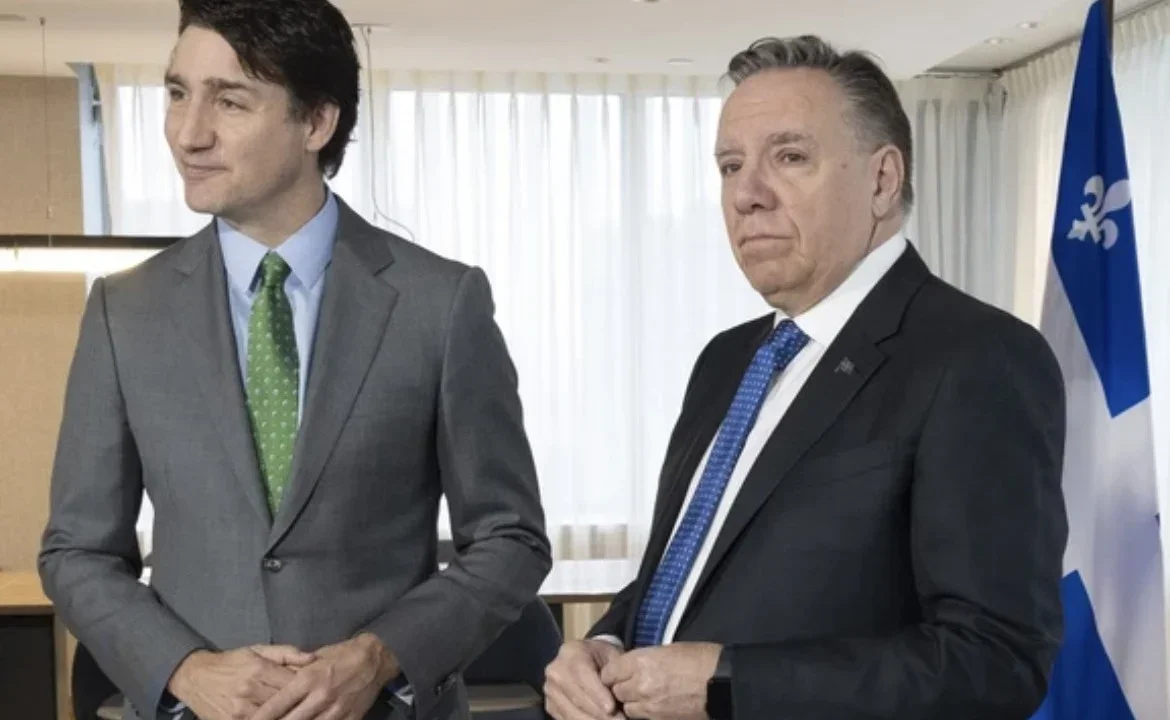
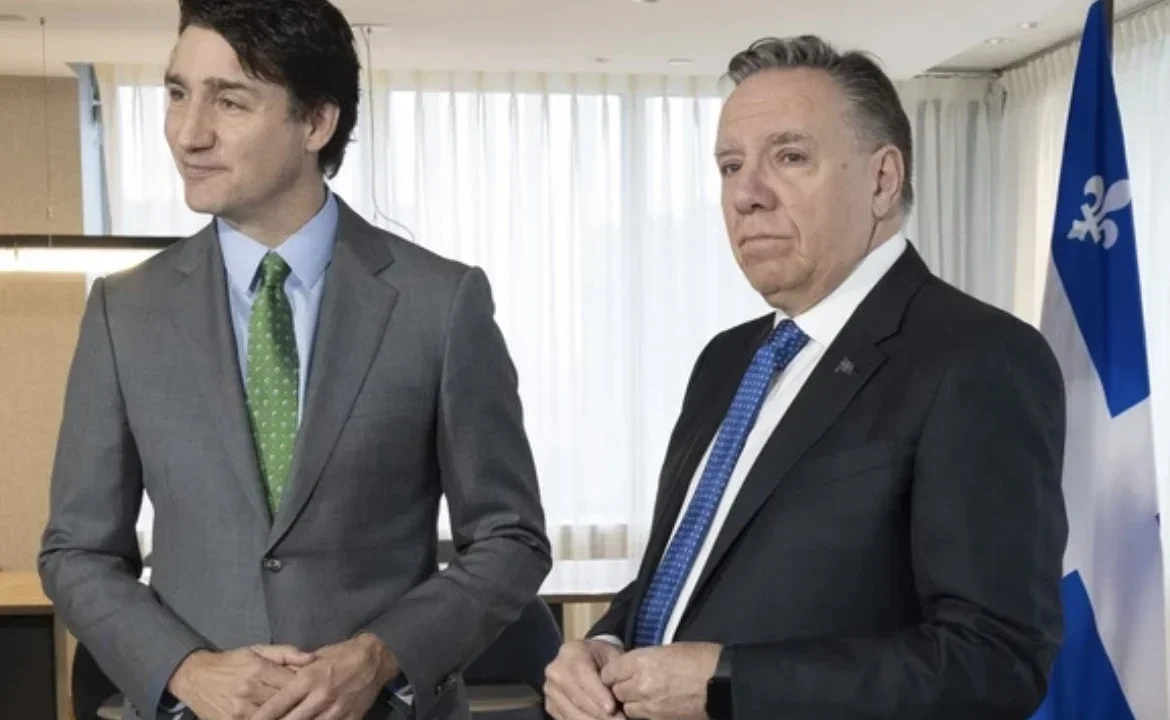
OTTAWA — Quebec Premier François Legault unexpectedly announced on Wednesday he would soon be resigning as leader just as his party, the Coalition Avenir Québec (CAQ), is expected to face a crushing defeat in an election year.
Article content
Sounds familiar? That is because, around this time last year, a deeply unpopular Prime Minister Justin Trudeau also announced he would step down as leader of the Liberal Party of Canada as soon as a successor was chosen. Former bank governor Mark Carney ended up replacing him weeks later, and the Liberals were re-elected for a fourth term.
In his address on Wednesday, Legault said he hopes the next provincial election, set to happen in October, will be focused on Quebec’s challenges instead of a desire for change.
Article content
“For the good of the party but above all the good of Quebec, I am announcing that I am resigning my role as Quebec premier,” he said.
Article content
Legault added he would stay in place as long as the CAQ finds someone to replace him. The party’s executive is expected to meet Wednesday evening to decide the road ahead.
Article content
“Being the premier of Quebec has been the greatest honour of my life,” he said.
Article content
Legault’s departure could have deep political ramifications at a time when the separatist Parti Québécois is dominating in the polls, and the Liberal Party of Quebec is searching for a new leader. So, why did he resign, and what does it mean for the future of the province?
Article content
Why did François Legault resign?
Article content
The news came just as another devastating public opinion poll showed that the CAQ is battling for last place in Quebec.
Article content
The Pallas Data poll, produced for The Walrus,shows that the Parti Québécois is in the lead with 34 per cent support, followed by the Quebec Liberals with 24 per cent support — despite not having a leader — and the Quebec Conservatives with 16 per cent.
The CAQ and Québec solidaire are tied for fourth place with 11 per cent of the votes.
Article content
Philippe J. Fournier, founder of the poll aggregating website Qc125, notes that the CAQ finds itself last outside of Montreal and Quebec City and among francophones — to the point where the CAQ could be completely decimated in the next election.
Article content
On a personal level, Legault remains the most unpopular premier in Canada.
Article content
Overall, 2025 was an annus horribilis for the Legault government.
Article content
After tabling a budget with a historic deficit of $13.6 billion, S&P Global downgraded Quebec’s credit rating for the first time in 30 years.
Article content
Quebec’s auditor general also revealed that a digital modernization by Quebec’s auto insurance corporation went half a billion dollars over budget — leading to the resignation of the minister of cybersecurity and digital affairs and prompting a public inquiry.
Article content
Finally, Quebec’s contentious Bill 2 caused the province’s doctors to revolt and to threaten to quit the province altogether. The adoption of the bill and the backtracking of its most contentious parts caused two of Legault’s closest ministers and allies to resign.
Despite all this, Legault continued to claim in year-end interviews that he would be staying on as Quebec premier and would be fighting to serve a third term in October.
Article content
The news of his resignation was kept under wraps until the very last instant. Only a handful of people knew he would be leaving before a news conference was called that morning.
Article content
Who could potentially replace Legault?
Article content
Because the news of his resignation was unexpected, there is no clear successor in sight.
Article content
It is also unclear whether the future CAQ leader will come from the inside or the outside.
Article content
What further complicates things is that only Legault has been at the helm of the party since its creation in 2011 and after it merged with the Action démocratique du Québec (ADQ) in 2012. Legault’s goal, when he took power in 2018, was to end the divisive battle on Quebec sovereignty that had dominated the political landscape in the province for 50 years.
Article content
For years, CAQ ministers Geneviève Guilbault and Simon Jolin-Barrette were viewed as natural successors to take on the party. But Guilbault’s reputation has been tainted in the fiasco over Quebec’s auto insurance corporation. For his part, Jolin-Barrette has tabled some of the CAQ’s most controversial reforms like Bill 21 and the Quebec constitution.
In separate statements on Wednesday, Guilbault said it was a “great privilege” to have learned so much from Legault, while Jolin-Barrette called Legault a “mentor.” They did not address if they intended to seek the leadership of the party after Legault’s resignation.
Article content
CAQ ministers Sonia LeBel and Christine Fréchette are also seen as rising stars and have taken on tough files in government. Their names have been floated as possible successors, but both women have so far given no indicators that they were interested in the job.
Article content
Another name that was floated as a possible successor was Mario Dumont, who founded the ADQ in 1994 and is now enjoying a prolific career as TV host in Quebec. But Dumont reiterated on Wednesday that he had no intention of making a return to provincial politics.
Article content
Dumont said “nothing” would make him change his mind.
Article content
What does this mean for the PQ?
Article content
As things stand, the Parti Québécois could strive to form a majority government next fall and keep its promise to hold another referendum in a first mandate.
Article content
However, as Abacus Data pollster David Coletto points out in a new Substack post, public appetite for Quebec to separate from the rest of Canada is limited and recent polling shows that most Quebecers would vote “no” if there was another referendum on the issue.
PQ Leader Paul St-Pierre Plamondon will be facing two different opponents in the next election.
Article content
The Quebec Liberals are poised to choose a new leader in March. Nearly everything indicates that will be former business executive Charles Milliard who has never been elected to public office. Second, the CAQ will be choosing their new leader in a timeline that has yet to be determined, and it remains to be seen if they can change the tides.
Article content
“The CAQ does not need to be loved to come back. It needs to be seen as the safer choice in a high-stakes moment,” writes Coletto. “The real question now is whether the party can seize this opening fast enough, and credibly enough, before voter fatigue hardens into something more final.”
Article content
“There’s a lesson in the Trudeau exit and Carney rise that I think applies to Quebec.”




Your comment will appear immediately after submission.