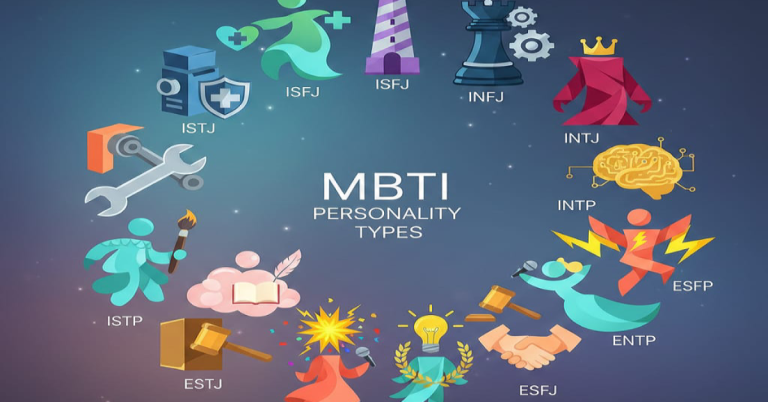
Understanding why people think and behave differently is one of psychology’s most intriguing questions. The Myers‑Briggs Type Indicator (MBTI) breaks down personality into 16 types, offering a powerful lens to decode how we communicate, work, and connect with others. These personality patterns are grounded in psychological science, helping readers make sense of their preferences and behaviors. For a deeper exploration of psychology concepts, research, and personality theory, visit All‑About‑Psychology.com — a trusted online resource for learners and enthusiasts alike.
Psychology
In today’s world of self- Finding out who you are and growing personally, getting to know your own character is super crucial these days A widely recognized personality framework globally is the MBTI, or Myers-Briggs Type Indicator Millions of people rely on it to get to know themselves better, enhance their relationships, pick out their careers, and even boost their businesses
But what exactly is MBTI?
Is it really useful?
How can this help you tap into your full potential
📈 Promote your Business
🕒 1st Month FREE + Lifetime Plan Available!
Let’s dive deep into the world of MBTI personality types.
What is MBTI Personality?
The Myers- The briggs Type Indicator, or MBTI, is a tool for figuring out personality types based on Carl Jung’s psychological ideas It sorts people into 16 distinct personality types depending on their
Focus their energy
Process information
Make decisions
Approach life and structure
MBTI is based on four key dimensions:
- Extraversion (E) vs Introversion (I) – Where do you draw your energy from
- Sensing (S) vs Intuition (N) – How you handle information
- Thinking (T) vs Feeling (F) – How do you make decisions
- Judging (J) vs Perceiving (P) – How you handle organization and planning
Extraversion (E) vs Introversion (I)
If you gain energy by spending time with people, you are extroverted. But if you gain energy by spending time alone, you are introverted. Take this introvert-extrovert personality test, to know yourself: https://tesvia.com/introvert-extrovert
A well‑written psychology article explaining the differences, traits, and how to tell which you may be. Introvert Vs Extrovert: Understanding Your Personality (ChoosingTherapy.com)
Sensing (S) vs Intuition (N)
Most people are sensors. If you focus on big picture and you are future oriented , you are intuitive. If you are detail-oriented and focus on more present, you are sensing.
Thinking (T) vs Feeling (F)
If you focus on logic, you are in the category of thinking. If you focus on what you feel, you are in the category of feeling.
Judging (J) vs Perceiving (P)
If you follow routine, you are in the category of Judging. If you don’t follow routine, you are in the category of perceiving. If your house is messy, you are perceiving. If house is clean and organized, you are judging category.
These combinations create 16 unique personality types.
The 16 MBTI Personality Types
The MBTI types are divided into four major groups:.
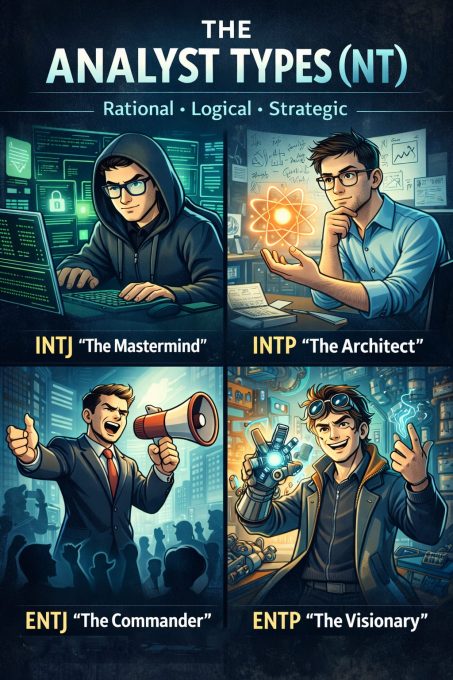
1. Analysts (NT Types)
Logical, strategic, and innovative thinkers.
INTJ – The Mastermind
INTP – The Architect
ENTJ – The Commander
ENTP – The Debater
Best for: Leadership, strategy, technology, entrepreneurship.
INTJ – The Mastermind
The INTJ MBTI personality type is strategic, independent, and future-focused. INTJs are long-term planners who rely on logic and vision to build powerful systems.
Famous Example: Mark Zuckerberg (Facebook Founder)
Biography: https://en.wikipedia.org/wiki/Mark_Zuckerberg
INTP – The Architect
The INTP personality type is analytical, innovative, and intellectually curious. INTPs love solving complex problems and exploring theoretical ideas.
Famous Example: Albert Einstein
Biography: https://en.wikipedia.org/wiki/Albert_Einstein
ENTJ – The Commander
The ENTJ MBTI type is bold, confident, and natural in leadership roles. ENTJs excel in business strategy and decision-making.
Famous Example: Elon Musk
Biography: https://en.wikipedia.org/wiki/Elon_Musk
ENTP – The Debater
The ENTP personality type is creative, outspoken, and loves intellectual debates. They challenge ideas and think outside the box.
Famous Example: Thomas Edison
Biography: https://en.wikipedia.org/wiki/Thomas_Edison
2. Diplomats (NF Types)


Emotional, intuitive, and idealistic personalities.
INFJ – The Advocate
INFP – The Mediator
ENFJ – The Protagonist
ENFP – The Campaigner
Best for: Counseling, writing, teaching, creative fields.
INFJ – The Advocate
The INFJ MBTI type is insightful, idealistic, and deeply intuitive. They are driven by purpose and emotional intelligence.
Famous Example: Nelson Mandela
Biography: https://en.wikipedia.org/wiki/Nelson_Mandela
INFP – The Mediator
The INFP personality type is creative, empathetic, and guided by strong personal values.
Famous Example: William Shakespeare
Biography: https://en.wikipedia.org/wiki/William_Shakespeare
ENFJ – The Protagonist
The ENFJ MBTI type is charismatic, inspiring, and people-focused. They thrive in leadership and mentorship roles.
Famous Example: Oprah Winfrey
Biography: https://en.wikipedia.org/wiki/Oprah_Winfrey
ENFP – The Campaigner
The ENFP personality type is energetic, imaginative, and enthusiastic. They inspire others with passion and creativity.
Famous Example: Robin Williams
Biography: https://en.wikipedia.org/wiki/Robin_Williams
3. Sentinels (SJ Types)
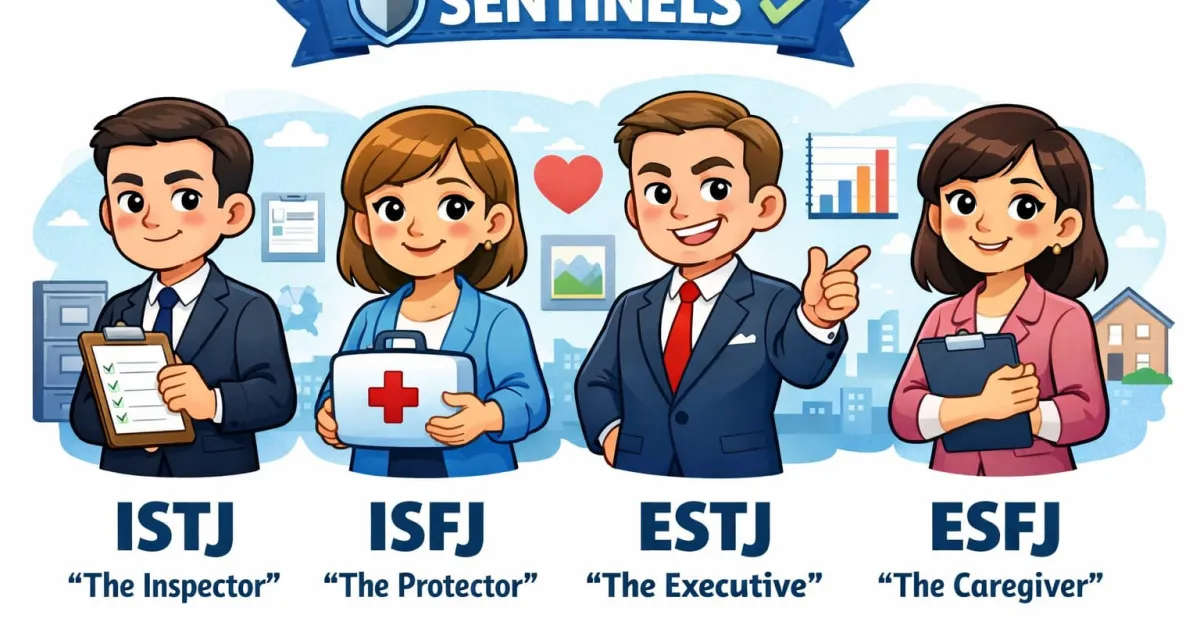
Responsible, organized, and practical.
ISTJ – The Inspector
ISFJ – The Protector
ESTJ – The Executive
ESFJ – The Caregiver
Best for: Administration, law, management, healthcare.
ISTJ – The Inspector
The ISTJ MBTI personality type is responsible, practical, and detail-oriented. They value structure and reliability.
Famous Example: Warren Buffett
Biography: https://en.wikipedia.org/wiki/Warren_Buffett
ISFJ – The Protector
The ISFJ personality type is loyal, caring, and protective. They are dependable and community-focused.
Famous Example: Mother Teresa
Biography: https://en.wikipedia.org/wiki/Mother_Teresa
ESTJ – The Executive
The ESTJ MBTI type is organized, assertive, and strong in management roles.
Famous Example: Indira Gandhi
Biography: https://en.wikipedia.org/wiki/Indira_Gandhi
ESFJ – The Caregiver
The ESFJ personality type is warm, social, and supportive. They value harmony and teamwork.
Famous Example: Taylor Swift
Biography: https://en.wikipedia.org/wiki/Taylor_Swift
4. Explorers (SP Types)

Flexible, energetic, and action-oriented.
ISTP – The Virtuoso
ISFP – The Adventurer
ESTP – The Entrepreneur
ESFP – The Entertainer
Best for:: Sales, sports, performing arts, emergency services.
ISTP – The Virtuoso
The ISTP MBTI type is practical, logical, and action-oriented. They enjoy hands-on problem solving.
Famous Example: Michael Jordan
Biography: https://en.wikipedia.org/wiki/Michael_Jordan
ISFP – The Adventurer
The ISFP personality type is artistic, sensitive, and spontaneous.
Famous Example: Michael Jackson
Biography: https://en.wikipedia.org/wiki/Michael_Jackson
ESTP – The Entrepreneur
The ESTP MBTI type is energetic, bold, and thrives in high-risk environments.
Famous Example: Donald Trump
Biography: https://en.wikipedia.org/wiki/Donald_Trump
ESFP – The Entertainer
The ESFP personality type is outgoing, fun-loving, and enjoys being the center of attention.
Famous Example: Marilyn Monroe
Biography: https://en.wikipedia.org/wiki/Marilyn_Monroe
Why MBTI is So Popular in 2026
MBTI is widely used in:
- Career counseling
- Corporate team building
- Relationship advice
- Personal development
- Content creation & social media psychology trends
Many companies use MBTI personality tests to improve teamwork and communication.
How to Know Your MBTI Personality
You can grab a free personality quiz from trustworthy sites like
- https://www.16personalities.com(popular and beginner-friendly)
- https://www.truity.com/test/type-finder-personality-test-new
- https://www.myersbriggs.org(official MBTI foundation)
How MBTI Can Help in Career Growth
Understanding your MBTI type helps you:
- Choose the right career path
- Improve communication skills
- Understand your strengths and weaknesses
- Build better relationships
- Increase productivity
For example: An INTJ might be really good at coming up with strategies and thinking ahead for the future
An ENFP could really shine in marketing, branding, or creating content
An ISTJ may perform well in structured, rule-based professions like law or finance.
MBTI and Relationships
MBTI is often used to understand romantic compatibility. Even though no one’s perfect, getting to know how people ar different helps us avoid fights
For example:
Thinking (T) types focus on logic.
Feeling (F) types focus on emotions.
Introverts need alone time.
Extroverts recharge through social interaction.
When partners understand these differences, relationships become stronger.
Is MBTI Scientifically Accurate?
MBTI has both supporters and critics
Strengths:
- Easy to understand
- Helpful for self-reflection
- Widely used in corporate settings
Limitations:
- Not a clinical diagnosis tool
- Personality can change over time
- People may fall between categories
It’s great for boosting self-awareness, not just a rigid label
Final Thoughts: Is the MBTI Test Worth Taking?
Any one of us who are looking to know ourselves on a deeper level, enhance our career paths or create deeper relationships can benefit enormously from taking a personality test.
MBTI has a lot to do with truly not putting yourself in a box.
It’s about figuring out your natural strengths.
The smarter you are, the more you understand your personality.
What is MBTI personality type in psychology?
The MBTI (Myers-Briggs Type Indicator) is a personality framework based on psychological theory that categorizes people into 16 personality types. It measures preferences in introversion vs extroversion, sensing vs intuition, thinking vs feeling, and judging vs perceiving.
What does MBTI stand for in psychology?
MBTI stands for Myers-Briggs Type Indicator, a personality assessment tool developed based on Carl Jung’s psychological theory. It categorizes individuals into 16 personality types by analyzing how they gain energy, process information, make decisions, and structure their lives.
What are the four MBTI personality dimensions?
The four MBTI dimensions are:
Introversion (I) vs Extroversion (E)
Sensing (S) vs Intuition (N)
Thinking (T) vs Feeling (F)
Judging (J) vs Perceiving (P)
These combinations create the 16 MBTI personality types.
What’s the difference between Thinking (T) and Feeling (F) in MBTI?
This dimension is about decision-making. Thinking (T) types prioritize logic, objectivity, and consistency when making choices. They focus on cause-and-effect and fairness based on rules. Feeling (F) types prioritize values, harmony, and person-centered concerns. They focus on empathy and the human impact of decisions. Both are rational processes; one is not more emotional than the other.
Can MBTI help in choosing a career?
Yes, MBTI personality types can help you identify career paths aligned with your strengths. For example, analytical types like INTJ or INTP may prefer strategic or technical careers, while people-focused types like ENFJ or ESFJ may thrive in leadership or communication roles.
Which MBTI personality type is the rarest?
INFJ is often considered one of the rarest MBTI personality types. INFJs are known for their deep intuition, empathy, and long-term vision.
Are introverts more intelligent than extroverts?
No personality type is more intelligent than another. Introverts and extroverts simply process energy and social interaction differently. Intelligence depends on multiple factors, not personality preference.
Is MBTI useful for relationships?
Yes, understanding MBTI personality differences can improve communication, reduce conflict, and increase emotional understanding in relationships.
Where can I take a free MBTI personality test?
You can take a free MBTI-style personality test from trusted psychology-related websites such as 16Personalities or other personality psychology platforms that explain introversion, extroversion, and cognitive preferences.
Your comment will appear immediately after submission.