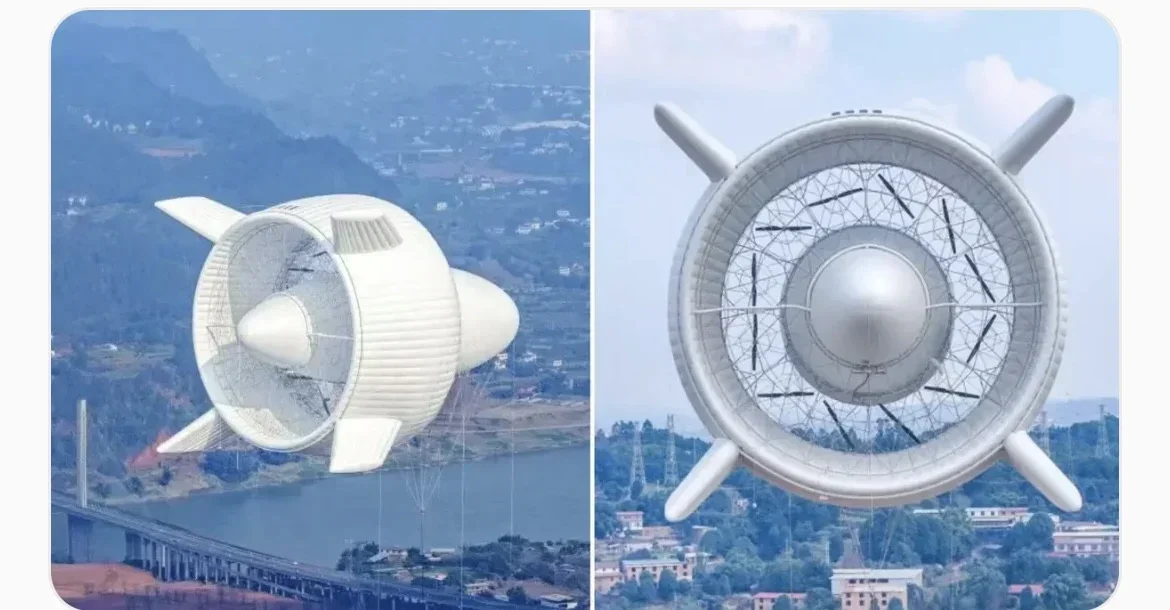
The helium-lifted S2000 system uses high-altitude winds and a ducted design with 12 turbines to reach a rated capacity of up to 3 megawatts.
A Beijing-based energy company has taken a major step toward commercial airborne wind power after completing the maiden flight and grid-connected power generation test of its megawatt-class system in Southwest China.
China has successfully completed the first flight of its home-designed floating wind turbine, the S1500, in Hami, Xinjiang.
The system passed strict tests, including full desert assembly and repeated deployments in high winds. This marks a major milestone for airborne wind power.
The S1500 is a megawatt-scale commercial system that floats in the sky like a giant Zeppelin. Measuring approximately 197 feet long (60 meters), 131 feet wide (40 meters), and 131 feet tall (40 meters), it is by far the largest airborne wind-power generator ever built, according to Beijing SAWES Energy Technology Co., Ltd., one of the developers.
Unlike traditional turbines, the S1500 does not need a tower or deep foundation. This reduces material use by 40 percent and cuts electricity costs by 30 percent. The entire unit can be moved within hours, making it suitable for deserts, islands, and mining sites.
The S1500 features a main airfoil and an annular wing that together form a giant duct. Inside this duct are 12 turbine-generator sets, each rated at 100 kW. These rotors capture steady high-altitude winds and convert them into electricity. The power is transmitted to the ground via a tether cable.
SAWES developed the airship with support from Tsinghua University and the Aerospace Information Research Institute (AIR) under the Chinese Academy of Sciences. Researchers mastered aerostat stability, ultra-light generators, and kilometer-scale high-voltage tethers to make large airborne wind systems feasible.
Previous prototypes paved the way for the S1500. In October 2024, the helium-filled S500 blimp reached about 1,640 feet (500 meters) above Hubei Province, producing over 50 kW.
Three months later, the S1000 climbed to roughly 3,281 feet (1,000 meters), doubling output to 100 kW. These incremental steps helped validate the concept of high-altitude energy harvesting.




Your comment will appear immediately after submission.