BEIJING — Prime Minister Mark Carney has arrived in China for the first visit by a Canadian prime minister in nearly a decade, marking a new era in diplomatic relations.
Carney received an invitation to travel to China after conversations in the fall of 2025 with the Chinese president at the sidelines of the ASEAN Summit in South Korea.
Canada’s Foreign Affairs Minister Anita Anand, travelling as part of the delegation, called the trip an important opportunity to find new areas of collaboration.
“It is a complex relationship but Prime Minister Mark Carney is here to recalibrate the Canada-China relationship,” Anand told reporters in Beijing on Wednesday.
China is Canada’s second largest since trading partner, with bilateral trade in 2024 totalling $118 billion. Until recently, relations between the two countries has essentially been frozen. In fact, Canada’s own Indo-Pacific strategy released in 2022described China as “an increasingly disruptive power.”
Asked whether that language is still accurate, the foreign affairs minister suggested change is in the air.
“This is a new government with a new prime minister, a new foreign policy and a new geopolitical environment,” said Anand. “In this moment of economic stress for our country it is necessary for us to diversify our trading partners.”
The Prime Minister’s Office views this trip as a stepping stone to a more stable relationship.
Canada-China relations deteriorated after Canadian authorities detained Huawei CEO Meng Wenzhou at the request of the United States in 2018. In retaliation, China detained Canadians Michael Spavor and Michael Kovrig.
What’s on the agenda?
While in Beijing the prime minister will meet with business leaders and government officials including the Chairman of the Standing Committee of the National People’s Congress Zhao Leji, and the Premier of the People’s Republic of China Li Qiang. He will also have a closed door meeting with President Xi Jinping on Friday.
York University Professor Gregory Chin says Chinese leadership knows the Canada-U.S. relationship is being tested and that increased trade with Canada can help the Chinese economy.
“They realize relations with Canada weren’t good for the last decade and that’s not in China’s interest,” Chin said, when asked why the Chinese president extended an invite to Carney.
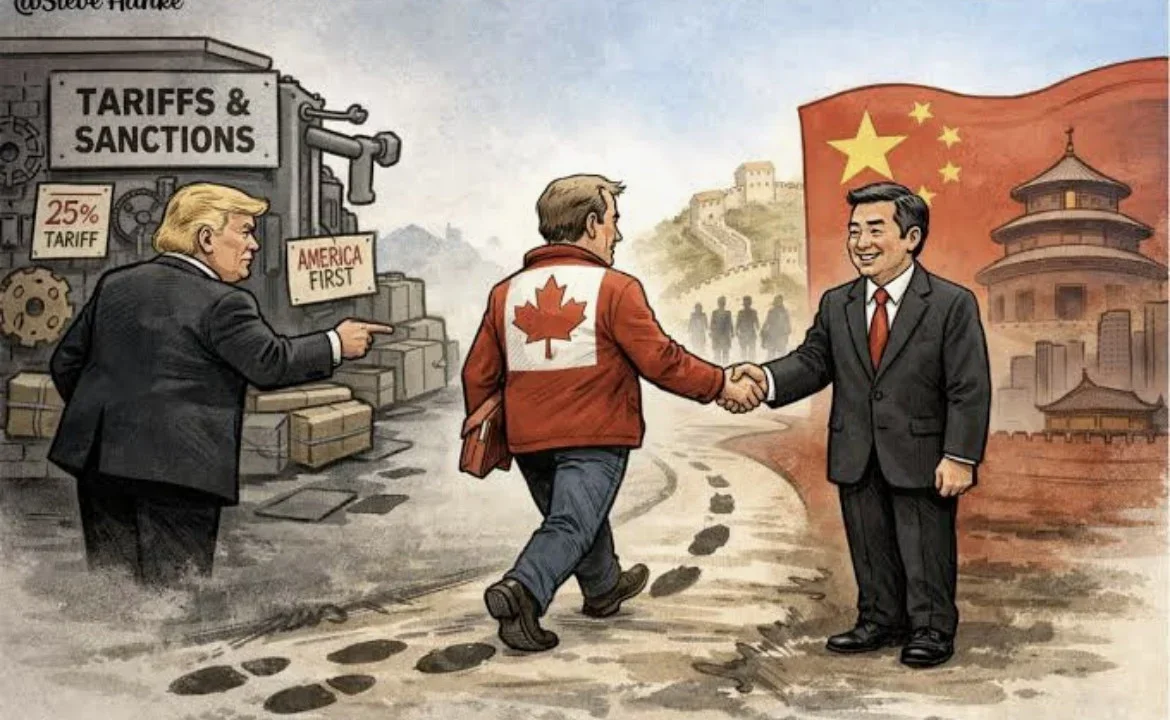
Trump’s tariffs have pushed Canada and China to look for new opportunities. In recent weeks, the Chinese president has welcomed the leaders of Ireland, Germany and France to Beijing. Canada, meanwhile, is seeking to double non-U.S. exports within a decade.
Carney’s aim while in China, and throughout his around-the-world trip, is to create new opportunities for trade and to encourage foreign business leaders to invest their capital in Canada.
“It’s an important opportunity for Canada to reset the relationship with China at a time when we’re obviously dealing with a much tougher United States, where our Canadian national interests have to be rethought,” Chin said.
While trade is expected to be the focus, agriculture, and energy will also be on the table when Carney and his five accompanying ministers meet with government and business leaders. On Thursday, Carney is expected to take part in a signing ceremony involving what sources will only say are energy and climate.
The prime minister has also said he intends to make clear to Chinese leadership that there are areas, including artificial intelligence and critical minerals, which Canada does not want to do business in.
The canola sector will be watching closely as it looks for progress towards the removal of punishing Chinese tariffs. In March 2025, China imposed a 100 per cent tariff on Canola oil and meal. Then, in August, China announced preliminary duties of 75.8 per cent on imports of Canadian canola seed. They have also introduced tariffs on other agricultural products including some Canadian pork and fish.
The President and CEO of the Canola Council of Canada Chris Davison says Chinese tariffs on canola products have effectively shut Canadian canola out of the Chinese market, which was valued at about $5 billion in 2024.
“So a very significant impact that’s being felt right through the canola value chain starting at the farm gate and moving through exporting, processing etc,” said Davison.
Davison says these are political issues that require a political solution and he hopes to see movement on these issues.
“Our ultimate goal is to restore market access to China, to have smoother, predictable trade with our number 2 export market,” he said. “We’re looking for signs of progress and resolution on that front.”
Government officials speaking on background before the trip said it’s reasonable to expect progress but not the “definitive elimination of tariffs in a single visit.” Those same officials also said to expect progress on what they called “trade irritants” and tariffs.
On Saturday, the prime minister will depart China for visits to Qatar and then Davos, Switzerland for the World Economic Forum.




Your comment will appear immediately after submission.