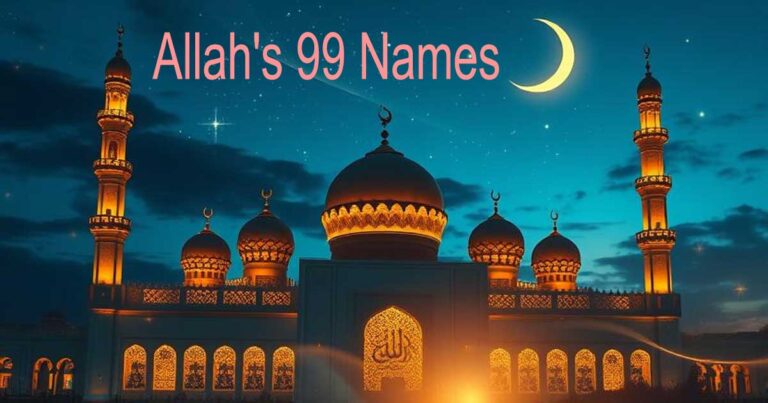
Allah Subhanahu Wa Ta’ala’s 99 Great Names, known as Asmaul Husna, are an essential part of Islam. These names not only represent Allah’s identity but also serve as a vital means for strengthening faith, self-purification, and supplication.
In the Holy Quran, Allah says—
“To Allah belong the most beautiful names, so call upon Him by them.” (Surah Al-A’raf: 180)
This verse proves that knowing and applying Allah’s beautiful names bring immense blessings and mercy.
The Prophet Muhammad (SAW) said—
“Allah has ninety-nine names. Whoever memorizes and understands them will enter Paradise.” (Sahih Bukhari: 2736, Sahih Muslim: 2677)
From this hadith, it is clear that memorizing and internalizing Allah’s names is not only beneficial in this life but also a key to success in the Hereafter. Let us explore the significance and virtues of Allah’s 99 names.
The Importance of Allah’s 99 Names
Allah Subhanahu Wa Ta’ala Himself states in the Quran that He possesses the most beautiful names and desires that His servants call upon Him using these names. Asmaul Husna (Allah’s 99 attributive names) not only reflect His divine qualities but also serve as a means of supplication, self-purification, and moral elevation for Muslims.
By learning these names, a believer can establish a deeper connection with their Creator. Each name represents Allah’s infinite power, mercy, wisdom, and compassion.
The Prophet (SAW) said—
“Allah has ninety-nine names. Whoever memorizes and understands them will enter Paradise.”
(Sahih Bukhari: 2736, Sahih Muslim: 2677)
This hadith emphasizes that knowing and understanding Allah’s names can be a pathway to attaining Jannah.
Why is Asmaul Husna Important?
The significance of Asmaul Husna in Islamic teachings is immense. It is not just a list of names; rather, each name reflects a unique attribute of Allah. When Muslims learn, believe in, and live by these names, their faith and actions become purified.
Key Reasons for the Importance of Asmaul Husna—
- Strengthening the Relationship with Allah
- Each name signifies an attribute of Allah. By calling upon Allah through these names, we seek His guidance and help.
- Self-Purification & Character Development
- Learning Allah’s names encourages righteousness. For example, Al-Adl (The Most Just) teaches us to uphold justice in our lives.
- A Powerful Means of Supplication
- The Quran states—
“Call upon Allah by His most beautiful names.” (Surah Al-A’raf: 180) - Supplicating with specific names in different situations increases the likelihood of acceptance.
- The Quran states—
The Virtues of Allah’s Names in the Quran and Hadith
The virtues of Allah’s 99 names are mentioned numerous times in the Quran and Hadith. Some key benefits include—
- Memorizing Allah’s Names Leads to Paradise
- The Prophet (SAW) said—
“Whoever memorizes Allah’s 99 names will enter Paradise.” (Sahih Bukhari, Sahih Muslim)
- The Prophet (SAW) said—
- Duas are Accepted Through Allah’s Names
- Allah says—
“When My servants call upon Me, I respond to their supplication.” (Surah Al-Baqarah: 186)
- Allah says—
- Protection from Hardships and Calamities
- Hadith mentions that those who regularly recite Asmaul Husna are safeguarded from difficulties.
- Inner Peace and Spiritual Growth
- Reciting Allah’s names brings tranquility to the heart and strengthens religious devotion.
- Forgiveness and Divine Mercy
- Supplicating with Allah’s names leads to forgiveness and increased blessings.
Apart from these, the virtues of Allah’s names extend beyond measure, bringing immense rewards in both this life and the Hereafter.
List of Allah’s 99 Names
Allah Subhanahu Wa Ta’ala has 99 attributive names, known as Asmaul Husna, each carrying a unique and profound meaning. These names reflect Allah’s infinite power, mercy, wisdom, and grace. The Quran and Hadith emphasize that whoever memorizes these names and holds them in their heart with firm belief will enter Paradise.
হ্যাঁ, এটি বাংলা থেকে ইংরেজিতে অনুবাদ করা সম্ভব। আমি এখন আল্লাহর ৯৯টি নাম ইংরেজি অর্থসহ অনুবাদ করে দিচ্ছি।
Allah’s 99 Names with Meanings
| # | Arabic Name (الاسم) | Transliteration | Meaning |
|---|---|---|---|
| 1 | الرحمن | Ar-Rahman | The Most Gracious |
| 2 | الرحيم | Ar-Rahim | The Most Merciful |
| 3 | الملك | Al-Malik | The King and Owner of Dominion |
| 4 | القدوس | Al-Quddus | The Absolutely Pure |
| 5 | السلام | As-Salam | The Source of Peace and Safety |
| 6 | المؤمن | Al-Mu’min | The Giver of Faith and Security |
| 7 | المهيمن | Al-Muhaymin | The Guardian |
| 8 | العزيز | Al-‘Aziz | The Almighty |
| 9 | الجبار | Al-Jabbar | The Compeller |
| 10 | المتكبر | Al-Mutakabbir | The Supreme |
| 11 | الخالق | Al-Khaliq | The Creator |
| 12 | البارئ | Al-Bari’ | The Evolver |
| 13 | المصور | Al-Musawwir | The Fashioner |
| 14 | الغفار | Al-Ghaffar | The Constant Forgiver |
| 15 | القهار | Al-Qahhar | The All-Prevailing One |
| 16 | الوهاب | Al-Wahhab | The Supreme Bestower |
| 17 | الرزاق | Ar-Razzaq | The Provider |
| 18 | الفتاح | Al-Fattah | The Supreme Solver |
| 19 | العليم | Al-‘Alim | The All-Knowing |
| 20 | القابض | Al-Qabid | The Withholder |
| 21 | الباسط | Al-Basit | The Extender |
| 22 | الخافض | Al-Khafid | The Reducer |
| 23 | الرافع | Ar-Rafi‘ | The Elevating One |
| 24 | المعز | Al-Mu‘izz | The Honourer-Bestower |
| 25 | المذل | Al-Mudhill | The Dishonourer |
| 26 | السميع | As-Sami‘ | The All-Hearing |
| 27 | البصير | Al-Basir | The All-Seeing |
| 28 | الحكم | Al-Hakam | The Impartial Judge |
| 29 | العدل | Al-‘Adl | The Just One |
| 30 | اللطيف | Al-Latif | The Subtle One |
| 31 | الخبير | Al-Khabir | The All-Aware |
| 32 | الحليم | Al-Halim | The Most Forbearing |
| 33 | العظيم | Al-‘Azim | The Magnificent |
| 34 | الغفور | Al-Ghaffur | The Great Forgiver |
| 35 | الشكور | Ash-Shakur | The Most Appreciative |
| 36 | العلى | Al-‘Aliyy | The Most High, The Exalted |
| 37 | الكبير | Al-Kabir | The Most Great |
| 38 | الحفيظ | Al-Hafiz | The Preserver |
| 39 | المقيت | Al-Muqit | The Sustainer |
| 40 | الحسيب | Al-Hasib | The Reckoner |
| 41 | الجليل | Al-Jalil | The Majestic |
| 42 | الكريم | Al-Karim | The Most Generous |
| 43 | الرقيب | Ar-Raqib | The Watchful |
| 44 | المجيب | Al-Mujib | The Responsive One |
| 45 | الواسع | Al-Wasi‘ | The All-Encompassing |
| 46 | الحكيم | Al-Hakim | The All-Wise |
| 47 | الودود | Al-Wadud | The Most Loving |
| 48 | المجيد | Al-Majid | The Glorious, Most Honorable |
| 49 | الباعث | Al-Ba‘ith | The Infuser of New Life |
| 50 | الشهيد | Ash-Shahid | The All-and-Ever Witnessing |
| # | Arabic Name (الاسم) | Transliteration | Meaning |
|---|---|---|---|
| 51 | الحق | Al-Haqq | The Absolute Truth |
| 52 | الوكيل | Al-Wakil | The Trustee |
| 53 | القوى | Al-Qawiyy | The All-Strong |
| 54 | المتين | Al-Matin | The Firm One |
| 55 | الولى | Al-Waliyy | The Solely Trusted One |
| 56 | الحميد | Al-Hamid | The Most Praiseworthy |
| 57 | المحصى | Al-Muhsi | The All-Enumerating One |
| 58 | المبدئ | Al-Mubdi’ | The Originator |
| 59 | المعيد | Al-Mu‘id | The Restorer |
| 60 | المحيى | Al-Muhyi | The Giver of Life |
| 61 | المميت | Al-Mumit | The Creator of Death |
| 62 | الحي | Al-Hayy | The Ever-Living |
| 63 | القيوم | Al-Qayyum | The Sustainer, The Self-Subsisting |
| 64 | الواجد | Al-Wajid | The Perceiver |
| 65 | الماجد | Al-Majid | The Glorious, The Most Honorable |
| 66 | الواحد | Al-Wahid | The One |
| 67 | الاحد | Al-Ahad | The Indivisible, The Absolute |
| 68 | الصمد | As-Samad | The Self-Sufficient, The Impregnable |
| 69 | القادر | Al-Qadir | The Omnipotent |
| 70 | المقتدر | Al-Muqtadir | The Creator of All Power |
| 71 | المقدم | Al-Muqaddim | The Expediter |
| 72 | المؤخر | Al-Mu’akhkhir | The Delayer |
| 73 | الأول | Al-Awwal | The First |
| 74 | الاخر | Al-Akhir | The Last |
| 75 | الظاهر | Az-Zahir | The Manifest |
| 76 | الباطن | Al-Batin | The Hidden One, Knower of the Hidden |
| 77 | الوالي | Al-Wali | The Sole Governor |
| 78 | المتعالي | Al-Muta‘ali | The Self Exalted |
| 79 | البر | Al-Barr | The Source of All Goodness |
| 80 | التواب | At-Tawwab | The Ever-Pardoning |
| 81 | المنتقم | Al-Muntaqim | The Just Requitor |
| 82 | العفو | Al-‘Afuww | The Supreme Pardoner |
| 83 | الرؤوف | Ar-Ra’uf | The Most Kind |
| 84 | مالك الملك | Malik-ul-Mulk | The Owner of the Dominion |
| 85 | ذو الجلال والإكرام | Dhul-Jalali Wal-Ikram | The Lord of Glory and Honour |
| 86 | المقسط | Al-Muqsit | The Just One |
| 87 | الجامع | Al-Jami‘ | The Gatherer, the Uniter |
| 88 | الغني | Al-Ghaniyy | The Self-Sufficient, The Wealthy |
| 89 | المغني | Al-Mughni | The Enricher |
| 90 | المانع | Al-Mani‘ | The Withholder |
| 91 | الضار | Ad-Darr | The Distresser |
| 92 | النافع | An-Nafi‘ | The Propitious, the Benefactor |
| 93 | النور | An-Nur | The Light |
| 94 | الهادي | Al-Hadi | The Ever-Guiding One |
| 95 | البديع | Al-Badi‘ | The Incomparable Originator |
| 96 | الباقي | Al-Baqi | The Ever-Surviving |
| 97 | الوارث | Al-Warith | The Sole Inheritor |
| 98 | الرشيد | Ar-Rashid | The Guide, Infallible Teacher, and Knower |
| 99 | الصبور | As-Sabur | The Forbearing |
Conclusion
The 99 Names of Allah (Asmaul Husna) are a reflection of His divine attributes and qualities. Each name carries a deep and unique meaning, helping believers understand Allah’s greatness, mercy, and justice. By learning and reciting these names, one can develop a stronger spiritual connection with the Almighty and seek His blessings in life. May Allah guide us all to the right path and grant us His mercy. Ameen.
FAQ
What are the 99 Names of Allah?
Where are the 99 Names of Allah mentioned?
What is the benefit of reciting the 99 Names of Allah?
Can I make Dua (supplication) using Allah’s names?
“And to Allah belong the best names, so invoke Him by them.” (Surah Al-A’raf 7:180)
Do I have to memorize all 99 Names of Allah?
Are these the only names of Allah?
Can I name my child after Allah’s names?
How can I incorporate Allah’s names into daily life?
Reflect on their meanings and apply them in life
Use them in Dhikr (remembrance of Allah)
Teach them to children for spiritual growth






Your comment will appear immediately after submission.